Restoration that moves with you.
A considered, no-shave approach for women whose hair is closely tied to identity, styling, and the way they present themselves each day — performed entirely within preserved length, by Datuk Dr. Inder.

Why hair visibility feels different for women.
For many women, hair sits closer to identity than to appearance. It is part of femininity, of daily routine, of how one is recognised in a room. Visible disruption — even briefly — touches more than the surface.
- 01
Tied hair, exposed temples
A simple ponytail, a braid, a low bun — the styles women rely on most often expose the very areas where thinning is first felt. The hairline is not hidden by length; it is framed by it.
- 02
Workplace visibility
In meetings, on calls, at the front of a room — a softer temple or widening part can carry a quiet weight, often noticed by the woman herself long before anyone else has reason to comment.
- 03
Social settings and closeness
Family gatherings, intimate dinners, school pickups, group photographs — settings where appearance is rarely the subject, but where being seen as oneself still matters.
- 04
Styling routines and continuity
Years of learning how a particular cut falls, how to part it, how to wear it for an evening. A visible interruption to that continuity is rarely just a cosmetic concern.
- 05
Femininity and emotional comfort
For many women, hair carries an emotional weight that is difficult to name and harder to explain. Decisions about it deserve to be considered with the same care.
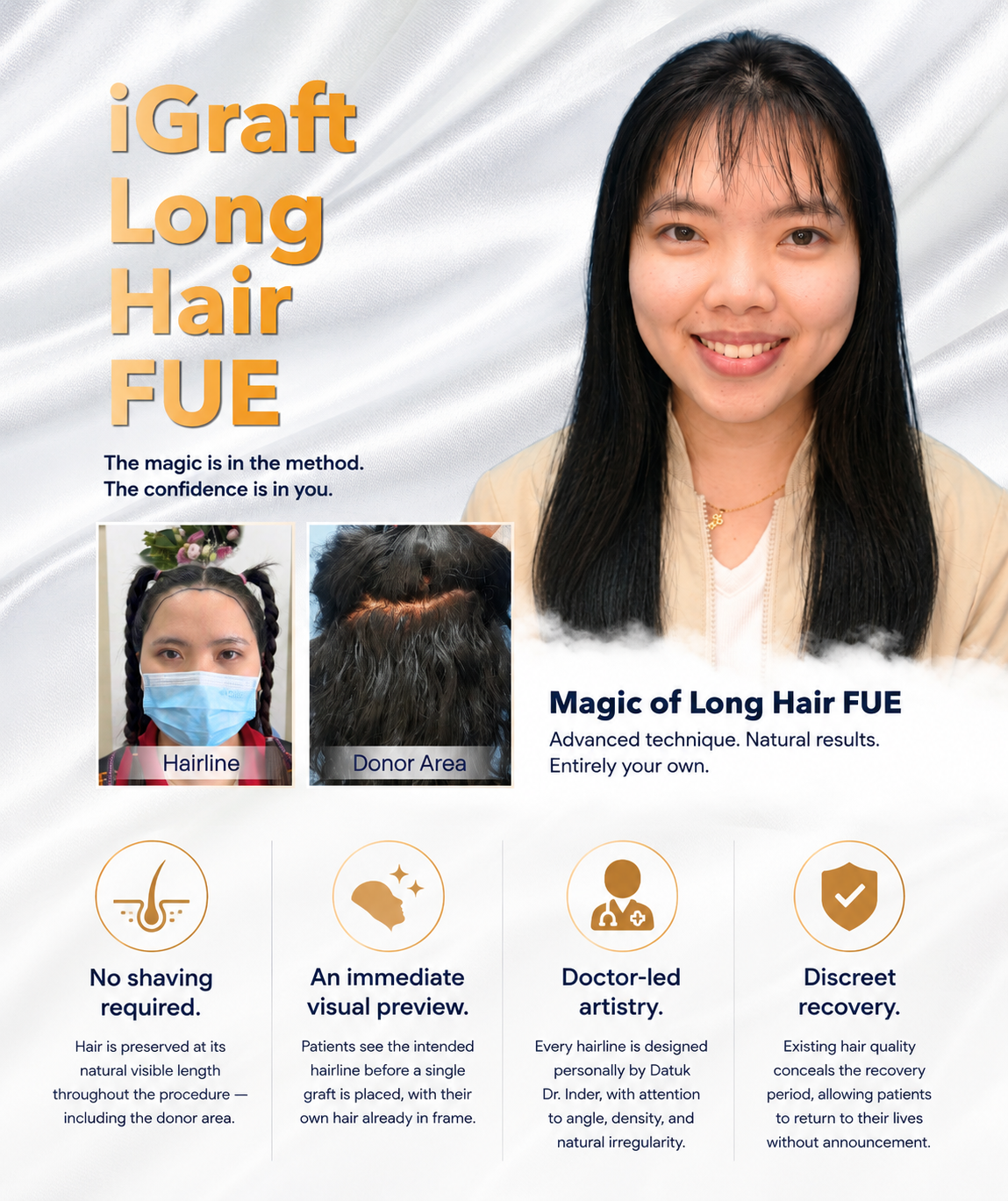
Why Long Hair FUE is especially suited to women.
- 01Strong surrounding density
Most women arrive with substantial density around the donor area. That existing fullness conceals the working zones throughout — and is one of the reasons the method translates so naturally to feminine cases.
- 02Length that protects continuity
Longer hair allows the procedure to take place beneath the visible surface. There is no shaved interval, no contrast, and no obvious moment when something has visibly changed.
- 03Reduced visual contrast during recovery
Rather than a stark before-and-after, the woman moves quietly through healing within her familiar styling — the kind of recovery that does not announce itself to the room.
- 04A familiar appearance throughout
Day to day, the patient continues to look like herself. The work is felt as continuity rather than as transformation — and that, for many women, is the point.
The aim is softness, not aggressive density.
Feminine hairlines are rarely defined by maximum density or precise geometry. They are defined by softness, gentle contour, believable transition, and the quiet harmony between the hair and the face it frames.
- 01
A soft, irregular leading edge
The frontal line is intentionally uneven — never drawn as a straight border — so it reads as nature rather than as design.
- 02
Gentle contour around the face
Temples, side framing, and the lateral hump are shaped with restraint, calibrated to the woman's existing facial proportion rather than to a template.
- 03
Believable transition zones
Density grades softly from the leading edge inward — denser behind, more delicate in front — so the result integrates with surrounding hair instead of standing apart from it.
- 04
Vellus hair preserved and respected
Fine surrounding hair is integrated into the design so the frontal frame retains the softness that distinguishes a feminine hairline from a corrected one.
- 05
Harmony with the woman's own face
Every decision — angle, density, position — is calibrated to her face, her age, and the way she has always worn her hair. The aim is recognition, not reinvention.
A recovery that respects the rest of your life.
Healing is real, and aftercare matters. The intent is not that nothing happens — it is that the woman can move through that period inside her familiar appearance, with realistic expectations and without unnecessary disruption.
- 01
Day 0
The procedure takes place within preserved hair. The patient leaves with her length intact and her usual styling possible — though gentle handling is asked of her in the early days.
- 02
Days 3–10
Most women resume ordinary routines quietly. Tied styles, soft handling, and the aftercare protocol are followed with care; closeness with family and work continue.
- 03
Months 3–6
Initial shedding settles within surrounding hair. New growth begins beneath existing length — typically before the patient herself sees a clear change in the mirror.
- 04
Month 12
The full character of the result is established — a softer frame and restored continuity that reads as her own hair, settled back into her own styling.
Movement, layering, and natural integration.
A feminine restoration is judged in motion — the way the hair falls, gathers, and behaves when she runs her fingers through it. Integration is as important as placement.
- 01
Natural fall and movement
Direction and angle are planned so restored areas move with surrounding hair — not against it — when the head turns or the hair is gathered.
- 02
Texture continuity
Curl pattern, fineness, and texture are considered so transplanted hair sits within the woman's existing texture rather than alongside it.
- 03
Layered styling considered
Layered cuts, partings, and the way the hair is usually worn are part of the design conversation — so the result reads correctly in her actual life, not only at consultation.
- 04
Soft integration at the boundary
Single-follicle grafts at the periphery let restored zones blend into surrounding hair gradually, with no visible edge between the two.
Femininity considered across years, not weeks.
A considered plan accounts for how a woman's hair is likely to behave over time — so the result remains believable, harmonious, and quietly age-appropriate across the decades that follow.
- Planning 01
Future thinning patterns
Female-pattern density change rarely stays still. The plan considers likely areas of future softening so the architecture remains coherent over time.
Female Hair Loss Treatment - Planning 02
Donor preservation
Conservative, considered use of donor hair preserves capacity for refinement later — rather than spending it all in a single intervention.
Female Hair Transplant Without Shaving - Planning 03
Age-appropriate softness
A line that flatters at thirty rarely flatters at sixty. Position, density, and softness are calibrated so the result ages with the woman, not against her.
Female Hairline Lowering - Planning 04
Long-term harmony
The aim is a frame that continues to read as her own hair through the decades — quiet, believable, and free of the markers that betray a procedure.
Temple Hair Restoration for Women
A frame that moves as her own hair.
Outcomes are documented privately and shared only in the considered context of consultation. The intent is restoration that reads as continuity — recognised, never announced.
Patient studies shared privately during consultation
Honest answers.
Continue exploring women's hair restoration.
Explore more specific approaches to feminine framing, hairstyle continuity, temple softness, thinning visibility, and long-term hair restoration planning.
- 01Explore
Female Hair Transplant Without Shaving
For women concerned about hairstyle continuity, shaving visibility, and maintaining a familiar appearance during recovery.
- 02Explore
Female Hairline Lowering
Focused on forehead proportion, feminine contour, and soft frontal framing.
- 03Explore
Temple Hair Restoration for Women
Focused on side framing, temple softness, and feminine silhouette refinement.
- 04Explore
Female Hair Loss Treatment
For widening part lines, diffuse thinning, and fullness-related visibility concerns.
A quiet conversation, at your pace.
Explore whether Long Hair FUE aligns with your hairstyle, your visibility concerns, and the long-term appearance goals that matter to you — in an unhurried, personal assessment with Datuk Dr. Inder.
ABHRS Diplomate · ISHRS Fellow · 30+ Years Experience