“I cannot imagine shaving my hair.”
The most common sentence women say in our consultation room — and the reason iGraft Long Hair FUE was refined the way it was. A considered approach for women whose hair is part of their daily routine, their styling, and the way they feel like themselves.

Why visible shaving feels different for women.
For most women, the resistance to shaving is not vanity. It is closer to identity — a quiet awareness that hair is part of how they move through the day, and how they are recognised within it.
- 01
Tied hair exposes the very areas treated
Ponytails, braids, low buns, soft updos — the styles women rely on most often draw attention to the temples, the part line, and the front. A shaved donor patch lives precisely where the hair is gathered.
- 02
Styling continuity, interrupted
Years of learning how a particular cut falls, how to part it, how to wear it for a long day. A visible shaved interval interrupts that continuity in a way that is felt long before it is discussed.
- 03
Femininity and emotional comfort
For many women, hair carries an emotional weight that is difficult to name. The decision to alter it — even temporarily — is rarely a small one, and deserves the same care as the result itself.
- 04
Workplace and social visibility
Meetings, presentations, school pickups, dinners with friends — settings where appearance is rarely the subject, but where being seen as oneself still matters quietly.
- 05
Daily routine, disrupted
Washing, blow-drying, styling, tying back — small rituals that hold the day together. Visible recovery turns ordinary moments into ones that need explanation.
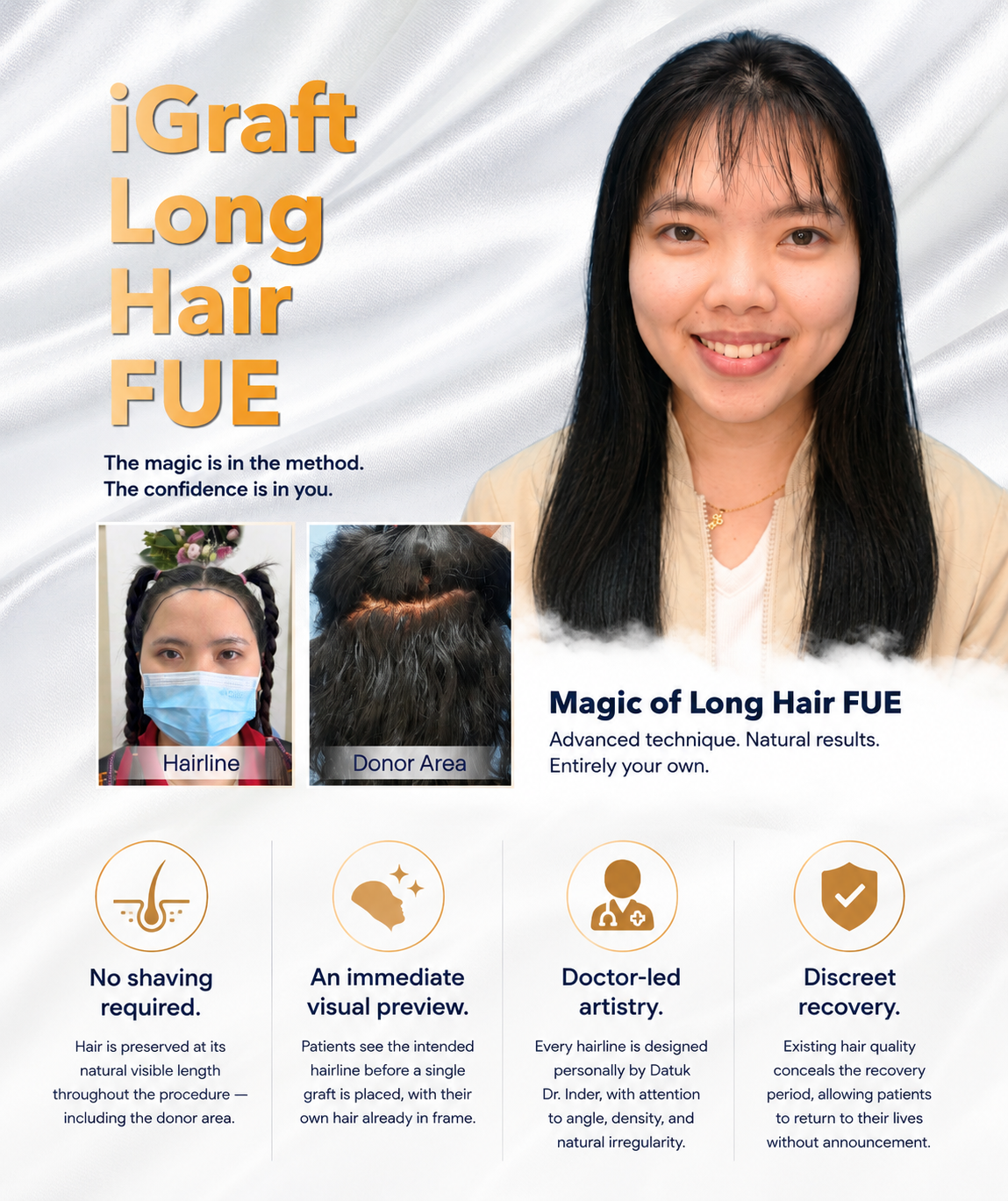
Preserving a familiar appearance.
- 01Hairstyle continuity, by design
The work takes place beneath visible length. Her usual cut, parting, and styling remain available to her — not as a marketing claim, but as the practical baseline of the method.
- 02Layers and natural movement preserved
Layered styling, soft fall, the way her hair gathers when tied — none of it is sacrificed to access the working area. Movement is part of what makes a feminine result believable.
- 03A recognisable appearance throughout
Day to day, she continues to look like herself. The change is felt as quiet continuity rather than as a sudden cosmetic event.
- 04Reduced visual contrast during recovery
Rather than a stark before-and-after, healing happens within her existing styling — softening the visible contrast that conventional methods create.
- 05Emotional normalcy held intact
Mirrors, photographs, family closeness, intimate moments — the parts of life most affected by visible disruption are quietly preserved.
Realistic recovery, lived inside her routine.
No-shave does not mean no recovery. It means the recovery happens beneath surrounding hair — and that her daily routine, with care, continues to look largely like itself. We are direct about what to expect, rather than promising that nothing happens.
- 01
Washing, with gentle care
A specific aftercare protocol guides washing in the early days — soft, careful, and clearly explained. Within the first week, most women return to a familiar washing rhythm.
- 02
Styling within the early window
Tied styles and gentle handling are usually possible early, with guidance. Heat tools and tight tension are paused for a defined period and then re-introduced gradually.
- 03
Public appearance during healing
Existing length conceals the working zones, so public moments are usually possible within days. Aftercare still asks for thoughtful planning around the first week.
- 04
Realistic healing expectations
Mild redness, sensitivity, and a normal shedding phase are real and expected. The intent is not that nothing happens — it is that what happens stays largely private.
- 05
A clear, single-doctor relationship
Aftercare is led personally by Datuk Dr. Inder — the same surgeon from first conversation through the twelve-month review.
Why Long Hair FUE is especially relevant.
Most women arrive with two qualities that suit this method unusually well — substantial surrounding density and longer hair. Both make preservation and careful integration not only possible, but sensible.
- 01
Surrounding density
Existing fullness around the donor area conceals the working zones throughout — and is one of the reasons the method translates so naturally to feminine cases.
- 02
Length that protects continuity
Longer hair allows the procedure to take place beneath the visible surface. There is no shaved interval, no contrast, and no obvious moment when something has visibly changed.
- 03
Careful integration at the boundary
Single-follicle grafts at the periphery let restored areas blend into surrounding hair gradually — with no visible edge between the two.
- 04
Movement and texture preserved
Direction, angle, and texture are planned so restored zones move with her surrounding hair, not against it, when the head turns or the hair is gathered.
The women who most often consider it.
Suitability is determined personally — but the patients who most often pursue the no-shave approach tend to share a few quiet priorities.
- 01
Hairstyle-led patients
Women whose styling, layering, and tied looks are part of how they move through the day.
- 02
Privacy-first patients
Women whose social and professional life cannot accommodate a visible recovery interval.
- 03
Hairline lowering candidates
Bringing a high or receded hairline gently forward, in proportion to the face.
- 04
Temple and part-line concerns
Reinforcing density where it is most often softened — temples, part line, and the soft frame.
A frame that moves as her own hair.
Outcomes are documented privately and shared only in the considered context of consultation. The intent is restoration that reads as continuity — recognised, never announced.
Patient studies shared privately during consultation
Honest answers.
Continue exploring women's hair restoration.
Explore more specific approaches to feminine framing, hairstyle continuity, and female thinning patterns.
- 01Explore
Long Hair FUE for Women
The feminine hub — soft framing, hairstyle continuity, and long-term planning across the decades.
- 02Explore
Female Hairline Lowering
Focused on forehead proportion, feminine contour, and soft frontal framing.
- 03Explore
Temple Hair Restoration for Women
Focused on restoring softness around the temples and gentle side framing.
- 04Explore
Female Hair Loss Treatment
For widening part lines, diffuse thinning, and density-related visibility concerns.
A quiet conversation, on her own terms.
Explore whether a no-shave female hair transplant approach is suitable for your hairstyle, your visibility concerns, and the recovery expectations that fit the way you actually live.
ABHRS Diplomate · ISHRS Fellow · 30+ Years Experience