Female hair restoration results designed for natural softness & confidence.
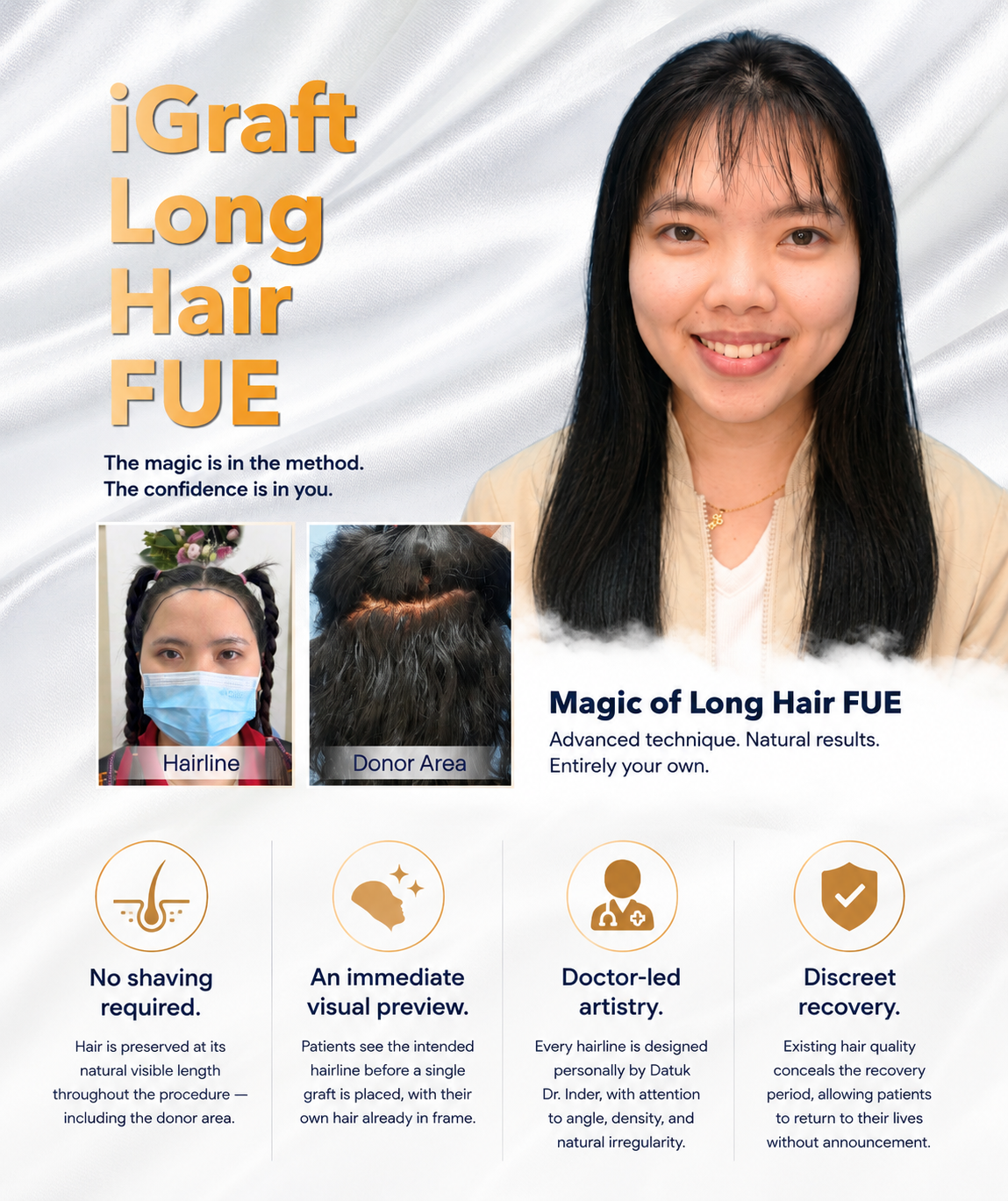
iGraft Long Hair FUE transformations for female hairline refinement, temple restoration, density enhancement, and discreet no-shave restoration — carried entirely within her own preserved hair, on her own terms.

Restoration that respects how she wears her hair.
This page is dedicated to female-specific transformations — hairline refinement, temple framing, diffuse thinning, and quiet density restoration. Each study is recorded the way the patient actually presents — hair down, hair tied, hair parted. The intent is restoration that integrates into her existing routine, never one that asks her to change it.
Studies, organised by concern.
Browse female-specific work by concern, framing area, and stage of growth.
- Hairline Lowering — Forehead Framing01
A higher hairline brought into proportion with the face — softer framing, quietly returned, entirely within preserved long hair.
- Concern
- Elevated hairline, broad forehead
- Area treated
- Frontal contour
- Why Long Hair FUE
- No shaving — performed within her own length
- Stage
- Month 12
- Naturalness
- Soft, irregular leading edge
 Hairline Lowering — Frontal Softness02
A softened, irregular frontal edge that reads as native hair — never a uniform line, never a drawn shape.
- Concern
- Hard or geometric frontal edge
- Area treated
- Frontal hairline
- Why Long Hair FUE
- Founder-drawn frontal design
- Stage
- Month 10
- Naturalness
- Density rises gently behind the edge
 Temple — Restored Framing03
Lateral temple framing softened and restored without shaving — the silhouette returned, hair down or tied.
- Concern
- Receded temples, lost side-frame
- Area treated
- Bilateral temples
- Why Long Hair FUE
- Restored without altering her existing styling
- Stage
- Month 12
- Naturalness
- Continuous with surrounding length
 Temple — Tied-Hair Confidence04
Temples restored so the patient can wear her hair pulled back without hesitation — the most exposed view, considered first.
- Concern
- Visible temples when tied
- Area treated
- Bilateral temples
- Why Long Hair FUE
- Designed around her real-life styling
- Stage
- Month 11
- Naturalness
- Reads as native at the most exposed angle
- Diffuse Thinning — Part Line05
Quiet density restored along a widening part line, integrated beneath preserved length and existing styling.
- Concern
- Widening part line, scalp visibility
- Area treated
- Mid-scalp / part
- Why Long Hair FUE
- Soft, distributed placement beneath her parting
- Stage
- Month 12
- Naturalness
- Even softness, no visible boundary
- Diffuse Thinning — Supportive Density06
Diffuse thinning across the mid-scalp supported with quiet, dispersed placement — never overcorrected, never dense to the point of artifice.
- Concern
- Diffuse mid-scalp thinning
- Area treated
- Mid-scalp
- Why Long Hair FUE
- Calibrated to native density, not above it
- Stage
- Month 12
- Naturalness
- Soft transition to existing hair
- Density Enhancement — Quiet Volume07
Visual weight quietly returned to the frontal third — fuller framing in photographs, without changing her cut or styling.
- Concern
- Loss of visual weight at the frame
- Area treated
- Frontal third
- Why Long Hair FUE
- Long Hair FUE preserved every centimetre of length
- Stage
- Month 12
- Naturalness
- Read as her own hair, in fuller form
- Framing & Softness — Side Profile08
Side-profile framing returned with gentleness — softer at the temple, balanced through the parietal, never sculpted.
- Concern
- Lost facial softness at the side profile
- Area treated
- Temple & parietal frame
- Why Long Hair FUE
- Hand-placed direction, no template
- Stage
- Month 12
- Naturalness
- Curvature respects her facial structure
 Framing & Softness — Corrective Refinement09
Refinement of prior work — softened transition, restored direction, and the femininity of the hairline returned.
- Concern
- Prior work, hard or unnatural framing
- Area treated
- Frontal & temple correction
- Why Long Hair FUE
- Hand-placed correction within preserved hair
- Stage
- Month 12
- Naturalness
- Direction and softness restored
- Donor — Day 710
The donor area, one week after the procedure, concealed entirely within her existing length.
- Concern
- Concern about visible donor recovery
- Area treated
- Occipital donor
- Why Long Hair FUE
- No shaving — long hair preserved completely
- Stage
- Day 7
- Naturalness
- Read at full visible length
- Donor — Week 411
Donor zone at week four — undisturbed, integrated, and continuing to style as her own hair.
- Concern
- Long-term donor visibility
- Area treated
- Occipital donor
- Why Long Hair FUE
- No styling change required at any stage
- Stage
- Week 4
- Naturalness
- Indistinguishable from surrounding hair
See the restored framing, within her own hair.
Because no shaving is performed, the patient leaves with her hair as she arrived — same length, same styling, same routine. The intended frontal line and temple framing can often be previewed the same day, within her preserved hair. The first reassurance arrives quietly, before regrowth has even begun.
- 01
Preserved length, throughout
Her hair is never cut, never shaved. The recovery happens entirely within her existing styling.
- 02
Same-day framing preview
The intended position of the new hairline and temples is visible the same day, in her own length.
- 03
Discreet return to social life
Many women return to work, family, and social settings within days — no caps, no explanations.
How a female result actually arrives.
The character of the work emerges across months — quietly, entirely beneath preserved hair, and without asking her to alter how she wears it. Each stage is documented with hair both down and tied.
- 01
Before
Baseline study with hair both down and tied, under standardised lighting.
- 02
Day 0 Preview
Intended hairline and temple framing previewed within her own length.
- 03
Month 3
Initial shedding settles, entirely within preserved hair.
- 04
Month 6
Early growth begins to redefine the frontal line and temples.
- 05
Month 12
Full character of the result is established — soft, integrated, her own.
Soft framing, in balance with her face.
Softer transitions
Density rises gradually behind the leading edge — never abruptly, never as a wall. The eye reads the result as native softness, not restored volume.
Facial balance
Position, curvature, and proportion are calibrated to her face — frontal third, temple frame, and parietal arc considered as one composition.
Temple contouring
Temples are contoured by hand to restore the side-frame she remembers, with curvature respectful of her natural silhouette.
Natural density softness
Visual weight is calibrated to her existing density, not above it. The work supports her hair, never overcorrects it.
No artificial straight lines
Female hairlines are irregular by nature. Every leading edge is hand-drawn, broken intentionally, and never arrives as a uniform line.
A feminine line, drawn with care.
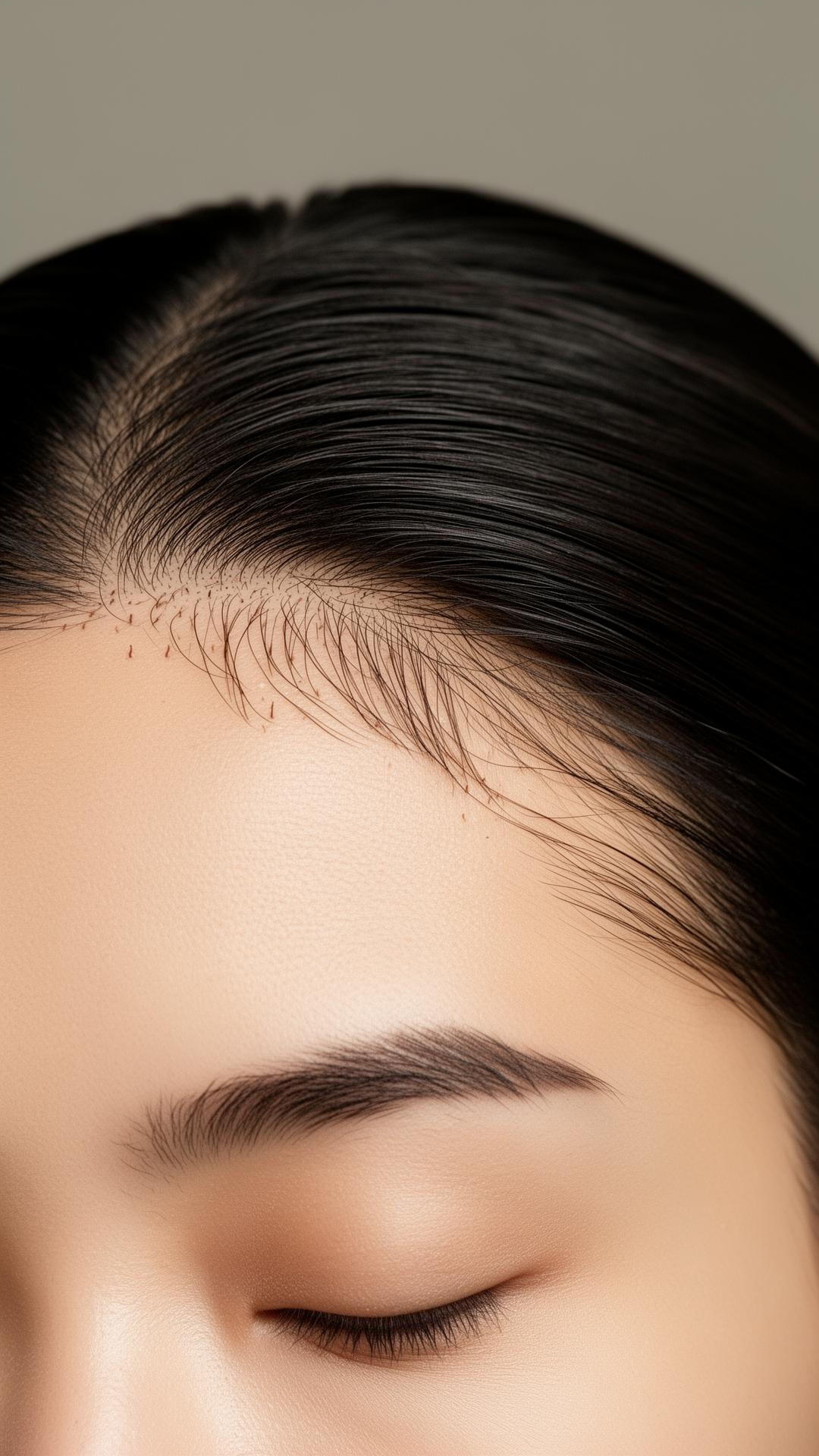
A natural female hairline is irregular, soft, and never uniform. These close studies show the transition that allows the result to read as native hair — even at the most exposed angle.
- Frontal SoftnessIrregular by design
- Temple FramingWithin preserved length
Donor area, never disturbed.
No shaving is performed at any stage. The donor area is read at its full visible length throughout, and continues to style and behave as the patient's own hair.
- Donor — Day 7Within length
- Donor — Week 4Concealed
- Donor — Month 3Integrated
Female studies, soon in moving image.
A small selection of female patient and clinical studies will be shared here in moving form — observed quietly, never as marketing.
- Coming soonTied-Hair StylingComing soon
- Coming soonBrushing Hair NaturallyComing soon
- Coming soonSide Profile FramingComing soon
- Coming soonForehead Framing in MovementComing soon
- Coming soonSoft Density Close-UpsComing soon
- Coming soonFemale Patient ReflectionsComing soon
- Coming soonDiscreet Recovery MomentsComing soon
- Coming soonDoctor ExplanationComing soon
What women tend to say.
- 01
“Nobody knew. My hair was never cut, never shaved. The result simply arrived, quietly, the way I would have wanted.”
Patient · Hairline lowering
- 02
“I can finally tie my hair back without thinking about my temples. I had not realised how much I had been hiding.”
Patient · Temple restoration
- 03
“It was the first consultation that did not ask me to change how I wear my hair. The plan was built around me, not around the procedure.”
Patient · Part-line density
- 04
“I returned to family and to photographs without hesitation. The softness of my framing came back, gently.”
Patient · Framing & softness
Most female work is shared in private.
By consent
Only patients who choose to share their studies appear publicly. Every other case remains entirely private.
Reviewed in consultation
A wider female archive is reviewed personally with Datuk Dr. Inder during private consultation, in considered context.
Confidentiality first
Identity, lifestyle, and timing are protected as a matter of course. Discretion is the default, particularly for women.
Continue exploring women's hair restoration.
Adjacent context for female patients — from the master gallery to specific concerns and a private review of cases relevant to your own framing.
- 01Results GalleryThe master proof of iGraft Long Hair FUE — across men and women.
- 02Female Hairline LoweringForehead framing softened, restored within preserved long hair.
- 03Temple Hair RestorationLateral framing returned for tied-hair confidence and softness.
- 04Female Hair Loss TreatmentDiffuse thinning, part-line visibility, and supportive density.
- 05Male Hair Transplant ResultsHairline, crown, M-shape, and density transformations in men.
- 06Private ConsultationReview female-specific cases personally with Datuk Dr. Inder.
Begin your private hair restoration assessment.
Every female restoration plan should consider facial proportions, density pattern, donor quality, styling preferences, and long-term naturalness. The first conversation is unhurried, founder-led, and held in considered private context.