Restoration considered around the work itself.
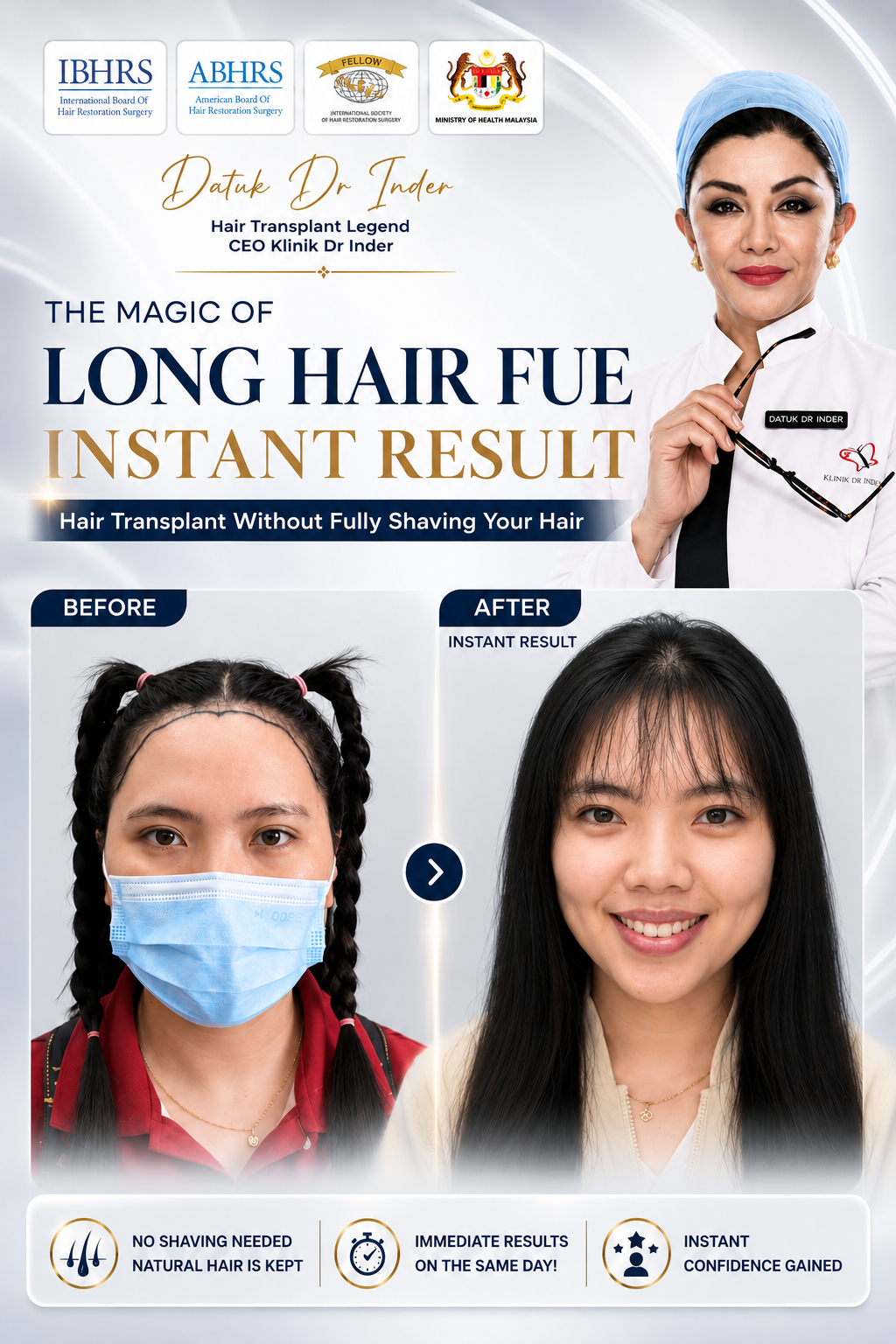
For some professionals, the question is rarely whether to restore — but how to do so without altering the visible continuity of their working life. Long Hair FUE is approached here as one part of that broader consideration.
When visible recovery becomes its own conversation.
For executives, founders, board members, consultants, and media-facing professionals, appearance is rarely a vanity concern. It is part of how a room is held, how authority is communicated, and how trust is established before a word is spoken. Visible recovery, in those settings, can introduce attention that the patient did not intend to invite.
- 01
Meetings, presentations, and consulting work
In rooms where credibility is established quickly, an unexplained change in appearance can shift the focus of attention before substantive conversation begins.
- 02
Leadership roles and team perception
Senior leaders are read continuously by their organisations. A visible procedure becomes a quiet topic of internal observation, regardless of whether it is ever discussed.
- 03
Media-facing and public interaction
On camera, on stage, or in published photography, an interim visible state is recorded — and circulated — in ways the patient cannot easily withdraw.
- 04
Travel, client visits, and continuity of access
Many senior schedules cannot accommodate a period of reduced visibility. The professional consequences of stepping away are sometimes greater than the procedure itself.
Less about transformation. More about continuity.
- 01Recognition rather than reinvention
The objective is for colleagues and clients to recognise the same person — not to register a noticeable shift in how he is presenting himself.
- 02Confidence held quietly
The intent is internal. Patients describe a steadier sense of how they appear in photographs, on screen, and in the daily mirror — without the result becoming a topic.
- 03Presence maintained over time
Senior careers extend across decades. The relevant question is rarely how a result reads next month, but how the appearance holds across the next ten years of professional life.
- 04Restoration that does not declare itself
The work is intended to be observed only as the patient's own hair — neither obviously restored, nor obviously cosmetic.
Subtle framing, considered carefully.
Small changes at the frontal line and temples can quietly affect how rested, alert, and present a face appears in professional settings. The approach focuses on natural integration with existing hair — not artificial density, not a youthful reset of the hairline.
- 01
A frontal line drawn for the present face
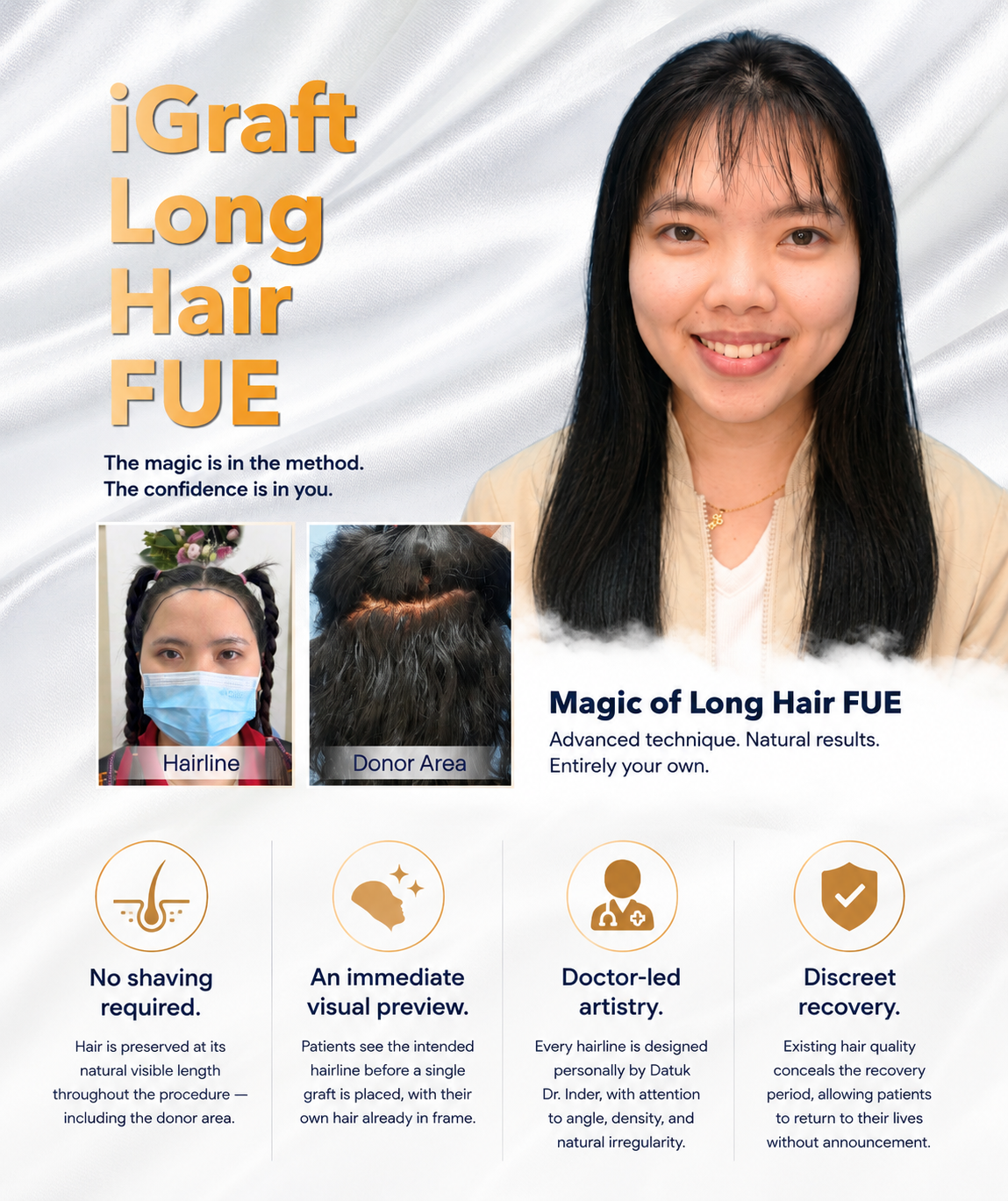
The hairline is designed personally by Datuk Dr. Inder, calibrated to facial structure and the patient's current stage of life — not lowered to recreate an earlier appearance.
- 02
Temples and lateral framing
Temple framing carries much of how a face reads as fatigued or composed. Selective work here is often more impactful — and more discreet — than concentrated frontal density.
- 03
Density placed for natural integration
Grafts are placed to read continuously with surrounding hair. The intent is fullness that belongs to the patient, rather than density that signals intervention.
- 04
Selective extraction within preserved length
Donor harvesting is conducted within the patient's existing hair length, so the back and sides of the scalp are not visibly altered during the working period.
- 05
A doctor-led, single-session process
The procedure is conducted in one continuous session by Datuk Dr. Inder, without technician hand-offs — appropriate for patients accustomed to direct accountability.
- 06
Privacy as a clinical standard
Consultations, scheduling, and follow-up are conducted by appointment, with the level of confidentiality expected at senior professional levels.
Reduced visible disruption. Not the absence of recovery.
Long Hair FUE is selected, in part, because it can reduce the visible footprint of the procedure for suitable patients. It does not, however, remove the medical realities of healing. Aftercare, follow-up, and the early weeks of recovery remain meaningful parts of the process and are planned around the patient's calendar with that in mind.
- 01
First days
The procedure ends within preserved hair. Outwardly, most patients leave looking close to how they arrived. Internally, the scalp is healing and requires careful aftercare.
- 02
First two weeks
Light professional activity is usually feasible for selected patients. Care instructions, sleeping position, and washing are followed precisely — restoration is a medical process, not a same-day appointment.
- 03
Months 3–6
Initial shedding settles and new growth begins beneath surrounding hair. The change is gradual and rarely registers as an event to anyone other than the patient.
- 04
Month 12
The full character of the result becomes established. Suitability for any patient — and the realistic timeline — is clarified at the personal assessment, not assumed in advance.
Considered now. Held across the years ahead.
The most considered decisions tend to be made by patients thinking less about how they will look in a year, and more about how they wish to be recognised across the next decade of professional and personal life.
- 01
Aging that holds its character
The intent is a result that ages alongside the patient — appropriate at fifty as it is at sixty — rather than one that becomes incongruent as the surrounding face matures.
- 02
A natural appearance, not a cosmetic one
Restoration that reads as the patient's own hair is preferred to density that draws attention to itself. The line between the two is the work of the consultation.
- 03
Thoughtful long-term planning
Decisions account for how surrounding hair may behave in coming years, so a single procedure is considered within a longer-term plan rather than in isolation.
- 04
Donor preservation as a long-view discipline
The donor area is treated as a finite resource, managed conservatively to preserve options for any future consideration the patient may wish to keep open.
A result the room reads as continuity.
Outcomes are documented privately and shown only in considered context during personal assessment. The intent is restoration that is recognised as the patient — not as a procedure.
Patient studies shared privately during consultation
Considered answers.
Continue exploring the executive perspective.
- 01Long Hair FUE for MenThe broader male perspective on restoration — frontal recession, crown thinning, masculine framing, and the considerations behind each.
- 02M-Shaped Hairline RestorationHow temple recession reshapes the upper frame of the face, and how the lateral line is rebuilt without flattening it.
- 03Crown Hair TransplantRestoring density at the vertex with attention to whorl, direction, and how the crown reads from the angles others see.
- 04ResultsQuiet documentation from the iGraft archive — observed across the patient's natural growth journey rather than presented as before-and-after marketing.
- 05Private ConsultationHow a first, confidential assessment is arranged with Datuk Dr. Inder — and what a considered plan looks like for senior professional life.
A considered conversation, on your terms.
A private assessment with Datuk Dr. Inder — to consider whether Long Hair FUE aligns with your professional responsibilities, visibility concerns, and long-term appearance over the years ahead.
ABHRS Diplomate · ISHRS Fellow · 30+ Years Experience